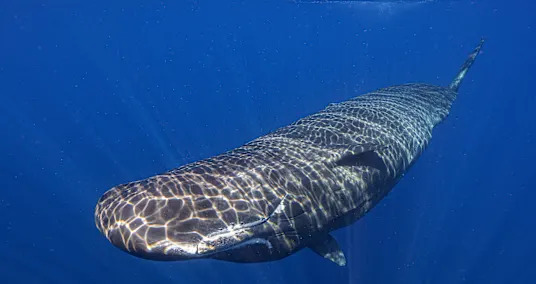
NEW YORK (AP) — Rare footage of a sperm whale giving birth has offered scientists a window into the behavior of these large, elusive mammals.
The video taken in 2023 shows female whales from two family lines working together to support the labor during critical moments and lift the newborn calf above the water. It's a level of coordination that's extremely uncommon in the animal kingdom, especially outside of primates like monkeys and humans.
“The group quite literally helps bring the calf into the world,” said Oregon State University behavioral ecologist Mauricio Cantor in an email. He had no role in the new research.
Scientists want to know how whales cooperate and socialize in the wild, but it's tough to study this in animals that spend most of their time underwater. There are just a handful of sperm whale birth records from the past 60 years, and all are anecdotal accounts or from whaling boats.
Several years ago, researchers were studying whale communication on a boat off the Caribbean island of Dominica when they noticed something odd. Eleven whales — most of them female — surfaced, their heads facing one another, and started thrashing and diving above and below the water. The scientists immediately took out drones and microphones to capture the event.
The full delivery took about 30 minutes. For hours afterward, pairs of whales held the baby above the water until it was able to swim.
“This was just really a special event,” said study co-author David Gruber with the Cetacean Translation Initiative, or Project CETI.
After observing the birth, the scientists created software to analyze exactly what was going on. They chronicled the sights and sounds in two studies published Thursday in the journals Scientific Reports and Science.
What struck the researchers was how many mother, sister and daughter whales united to support the new calf, even ones that weren't related. Sperm whales live in close-knit, female-led societies, and the new observations show how those dynamics persist in the animals' most significant and vulnerable moments.
“It's amazing to think about how, when faced with this impossible challenge, these animals come together to succeed,” said study co-author Shane Gero, also with Project CETI.
Scientists also noticed that the whales made different sounds during key moments of the birth, including slower, longer sets of clicks. These noises could have aided with communication, helping the animals sync up for the birthing effort.
The findings unearth a trove of questions. How did the group of whales form in the first place? How did they know to join?
It's unclear when scientists might figure out the answers, especially when video footage is scarce and so hard to secure. But the new findings can at least partially clue us into the whales' hidden conversations.
“I think it's just exciting to think about the social lives of these animals,” said biologist Susan Parks with Syracuse University, who wasn't involved with the new studies.
___
AP video journalist Mustakim Hasnath contributed to this report.
___
The Associated Press Health and Science Department receives support from the Howard Hughes Medical Institute’s Department of Science Education and the Robert Wood Johnson Foundation. The AP is solely responsible for all content.
LATEST POSTS
- 1
 Ancient fire discovery marks significant milestone in human history
 - 2Greenland’s melting ice and landslide-prone fjords make the oil and minerals Trump is eyeing dangerous to extract
- 3Space Condos to Lift Your Metropolitan Living
- 4Am I a Summer, or is this a scam? What I learned from color analysis.
- 5A somber Thor is returning for 'Avengers: Doomsday': Watch the dread-filled teaser




- Presenting Nintendo's New Pastel Satisfaction Con Tones for Switch Gamers: 3 Upscale Choices
- The Main 20 Gaming Control center Ever
- The Best Web-based Courses for Ability Advancement
- Egypt's cafés and shops forced to close early due to Iran war
- Figure out How to Introduce Sunlight powered chargers on Your Rooftop securely
- Flu is rising rapidly, driven by a new variant. Here's what to know
- Flu season is ramping up, and some experts are "pretty worried"
- Artemis 2 astronauts arrive at Kennedy Space Center ahead of NASA's historic launch around the moon
- Witness the elegance of the cosmic butterfly in a remarkable telescope photo